
(Note, the colors and styles of the blooms will vary! these are just examples)
Click here for photos of some of these blooming!
Order of blooming (roughly - will vary greatly with how much sun and heat the plant gets; shadier plants will be delayed):
Snow Drops - Squill - Daffodils/Hyacinth - Tulips - Allium - Iris - Daylilly
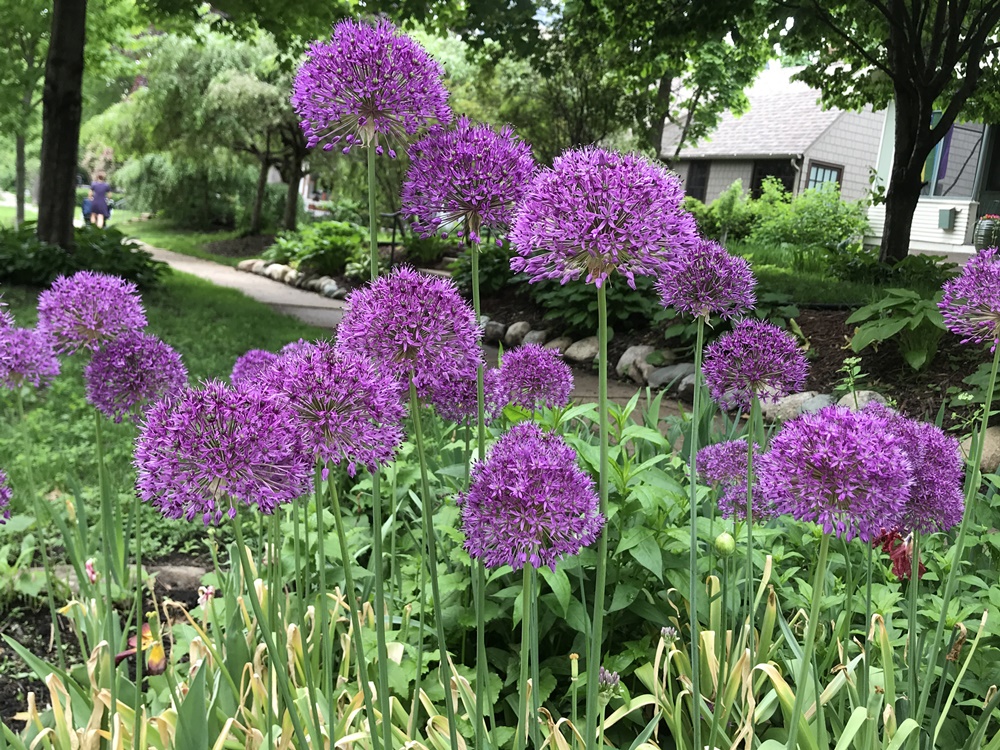
Allium: This is a large ornamental plant in the onion/chives/garlic family. It has one large bloom per plant, so it's often planted in groups. The initial shoots have a sort of 'starburst' pattern and they diverge immediately (unlike say a Hyacinth which pops up and then opens). If you catch them early you might still see a little yellow or red on the tips of the leaves. There are broader and narrower leafed versions. Most of the flowers are purple, but some pink and white varieties exist. These bloom later in Spring, like Irises.


Crocus: If you catch them super early, they start out as a small white spike coming out of the ground (this is usually mostly or entirely covered by dirt or leaves). Once sprouting, they look like small bunches of grass, sometimes with a white stripe down the middle of the leaves. Frequently you can identify them by the fact that by the time you see them, they are already blooming. Available in many colors; such as white, purple, and yellow.


Daffodil: Groups of wide blade shaped leaves that are all parallel to each other. The groups of shoots grow in pairs from bulbs. The flower eventually emerges in the center (see far right photo). Daffodils bloom after the crocus and squill, but often before tulips.


Day Lily: Often you'll find them in big groups. They can have the same sort of faded appearance that Irises get because they are re-growing from a previous season. Day lily shoots will have multiple triangular leaves coming off of a central point, but unlike Irises they are wrapped around each other instead of side by side.


Iris: Very pointy blades growing from a single point, usually look more faded than other bulb leaves (on the right you can see new growth from a bulb that still has the dead leaves from last year attached). The leaves all grow in a single flat plane. Iris bloom late in Spring, well after the daffodils and tulips.


Siberian Squill: Looks a bit like a smaller, blue crocus (though can have multiple flowers). The leaves are slightly more substantial and fewer in number than crocus leaves. Another one that is as like as not to be blooming by the time you see it.


Snowdrops: Common snowdrops (left) look similar to crocus or squill when first coming up. Giant snowdrops (center and right) look a little more like curved daffodils. They will, however, be out in force much earlier in the season.


Bulb was eaten by a rodent: There is a hole where you planted the bulb.

This happened to all but one bulb that I planted in my front yard, while all my backyard bulbs are fine. I believe this is because my dog runs around my backyard, and the rodents were smart enough to stay away. I've also heard that placing chicken wire or similar items over the bulbs can work, because it will keep animals from digging but allow the bulb to grow through it.
Early Arrivals that are NOT bulb plants:
There are quite a few other common early shoots that spring up that can look similar to the above plants but are non-bulb. Here are a few of them:
Hosta:
Usually in a vaguely circular clump, hosta spikes are, well, spikey. They look a little like a cross between a tulip and hyacinth spike but they are in groups. If the leaves from the previous year haven't been cleared out they will also be surrounded by lots of dead leaf material. They are a little more purple often right at the beginning, then can turn more green or white depending on the type of hosta.


Peonies:
Peonies also grow in roundish clumps. Peonies are odd in that they come out of the ground a very striking red color, even though the final plant is green. They are little frilly red tops on red stalks.


Bleeding Hearts:
Bleeding hearts have a bit of a similar appearance to peonies at first but they get 'frilly' faster and have more leaves instead of long empty stalks. They also fade from red to green very quickly.


Lily of the Valley
Lily of the Valley are very thin little tubes that grow in spaced out groups. Unlike the other hosta and peonies etc, Lily of the Valley grow in larger masses because it is many individual root connected plants rather than a single round clump. Lily of the Valley are also much smaller, more delicate looking shoots.


Thanks to Theatrum Botanicum for some of the IDs!


